
At the beginning of this school year, posters went up around the halls of BHS featuring an AI-generated Bucky Beaver holding a phone and with slogans like “Pack it or Park it.” The posters listed the rules of the new cell phone policy. Students are now required to have phones and wireless earbuds off and away during class at all times. If teachers see phones out, they can confiscate them for the rest of the day. Exceptions to the off-and-away rule are during passing time and lunch.
The policy came about as Beaverton School District has joined a growing number of school districts across the country banning cell phone use in classrooms. According to the BHS administration, the decision came as a result of increased distraction in the educational environment and mounting evidence of the harmful effects of cell phones on the mental and social well-being of teenagers. Principal Andrew Kearl wrote in an email newsletter on August 12th, 2024 that the goal of the new policy was to “decrease distractions, increase engagement, and ultimately boost student achievement.”
Sherri Kurczewski is an English teacher at BHS who teaches 10th grade Literature & Composition and College Composition. She said the impact of the phone policy has been positive for students. “I feel like students needed it and wanted it, but they didn’t know they needed it and wanted it,” she said.
Since the policy went into effect, she has noticed increased engagement and social interactions in her classroom. Students are making more eye contact with one another and getting involved in class discussions. She feels that, for the most part, students have been following the policy and compared to the level of distraction in past years, it’s “night and day.”
AP Statistics, AGS 2, and Data Science & Statistics teacher, Hailey DeMarre, discussed how the cell phone situation has changed since she began teaching in 2015.
Students used to need cell phones to access the internet for school resources. Sometimes there were not enough calculators in the classroom to go around, and “instead we’d go to our phones to use a scientific calculator or graphic calculator,” said DeMarre. However, since the district started its Chromebook program for all middle and high school students, the need for phones in class has become obsolete.
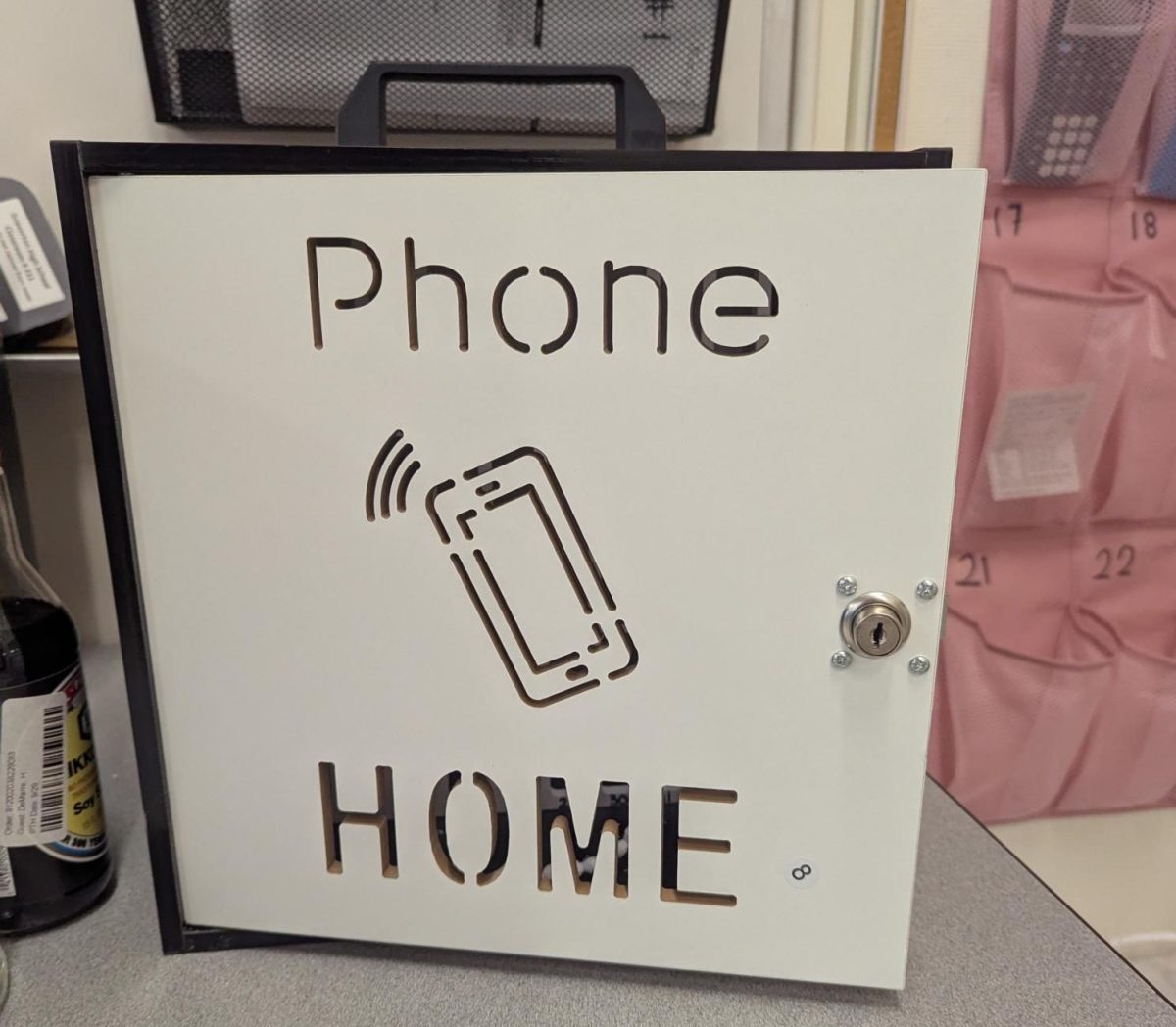
In September, DeMarre purchased a “Phone Home” for her classroom, a safe with slots for 33 phones. DeMarre collects phones at the start of class to take attendance and locks the phones in the box for the remainder of class. She purchased the phone home to avoid wasting time confiscating phones and to focus on teaching. The phone home eliminates the distraction. “It’s in the box. No one has to worry about it,” said DeMarre.
As for the students, who the policy affects most, many seem neutral about the policy. Senior Owen Chan already had to avoid the cell phone distraction to keep up with his advanced coursework.
“It hasn’t improved [my focus],” said Chan. “But I can see the utility of it for others.”
The policy gives teachers more leverage to help struggling students focus in the classroom. While before the rules were set by each teacher, the schoolwide policy gives students and teachers a clear set of expectations.
“You need to have some form of a rule,” said Kurczewski. “It’s not [necessary] for every kid, just for some kids who need that structure.”


![District changes have led to restrictions on AP classes for underclassmen [Graphic made with Canva].](https://beavertonhummer.com/wp-content/uploads/2024/06/Comic-Bonanza.png)